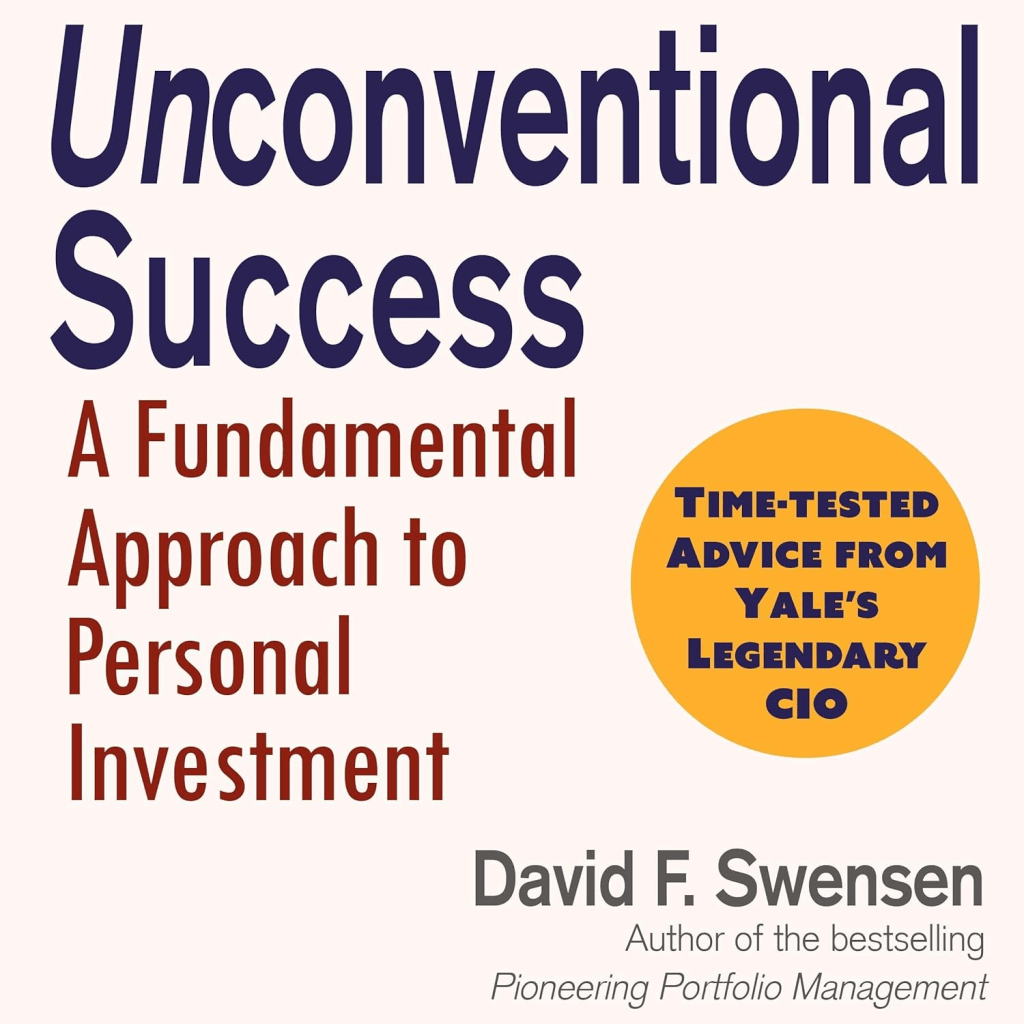
• If you’ve ever felt confused or skeptical about mutual funds, financial advisors, or even index investing, Unconventional Success by David F. Swensen is a must-read. This book is more than just an investment guide — it’s a brutally honest message from one of the most successful institutional investors, directed at everyday investors like you and me.

    About the Author: From Ivy League to Individual Advocates

    David Swensen served as the Chief Investment Officer of Yale University’s endowment fund, achieving an impressive 13%+ annualized return over two decades — far above the market average. But ironically, this book doesn’t encourage you to copy his strategy.

    Why?
    Because as individuals, we simply don’t have access to the same resources and opportunities as large institutions like Yale.

    So, what should we do instead?

    Swensen’s answer is clear:
    Adopt a low-cost, passive, long-term, and well-diversified investment strategy.


    Core Insights from the Book

    1. Actively Managed Funds: High Costs, Low Value

    Swensen pulls no punches when criticizing the mutual fund industry:

    • High fees eat into returns
    • Manager performance is inconsistent
    • Conflicts of interest hurt investors

    “Most mutual funds exist to enrich the fund managers — not the investors.”

    2. Passive Investing Wins Over Time

    Swensen strongly recommends individual investors stick with low-cost index funds — like Vanguard’s Total Stock Market or Total Bond Market Index Funds.

    Why? Because passive investing:

    • Delivers market-level returns
    • Minimizes unnecessary risk
    • Focuses on what you can control: fees, diversification, discipline
    3. Asset Allocation Is Everything

    Swensen proposes a sample diversified portfolio:

    • U.S. equities (30%)
    • Foreign developed equities (15%)
    • Real estate investment trusts — REITs (20%)
    • U.S. Treasury bonds (15%)
    • TIPS (inflation-protected bonds) (15%)
    • Cash or short-term bonds (5%)

    This mix aims to balance risk across asset classes, creating a resilient long-term portfolio — not just a stock market bet.


    Why This Book Still Matters

    Though published in 2005, the ideas in this book are more relevant than ever in today’s chaotic investing world:

    • Ignore hype and speculation
    • Be skeptical of Wall Street’s promises
    • Focus on cost, behavior, and long-term thinking

    Whether you’re tempted by meme stocks, crypto, or the latest robo-advisor, Swensen’s grounded wisdom offers a much-needed anchor.


    The Real Message: Be Different to Succeed

    The title Unconventional Success says it all. In a world obsessed with shortcuts and forecasts, Swensen reminds us:

    “True investment success comes not from chasing trends, but from choosing a patient, cost-effective, and thoughtful approach.”

    In a noisy financial world, this book offers clarity and conviction.
    If you’re building your own long-term investing philosophy, Unconventional Success can be your compass.


    📘 Get your copy of Unconventional Success herehttps://amzn.to/4l1nSjd

    Note: This is an affiliate link, which helps support this blog at no extra cost to you.
  • Have you ever wondered: How should I even start investing?
    With thousands of mutual funds, stock options, and financial products, it’s easy to feel overwhelmed. Picking individual stocks is stressful, financial advisors often pitch complex products, and most strategies sound like they’re made for Wall Street insiders.

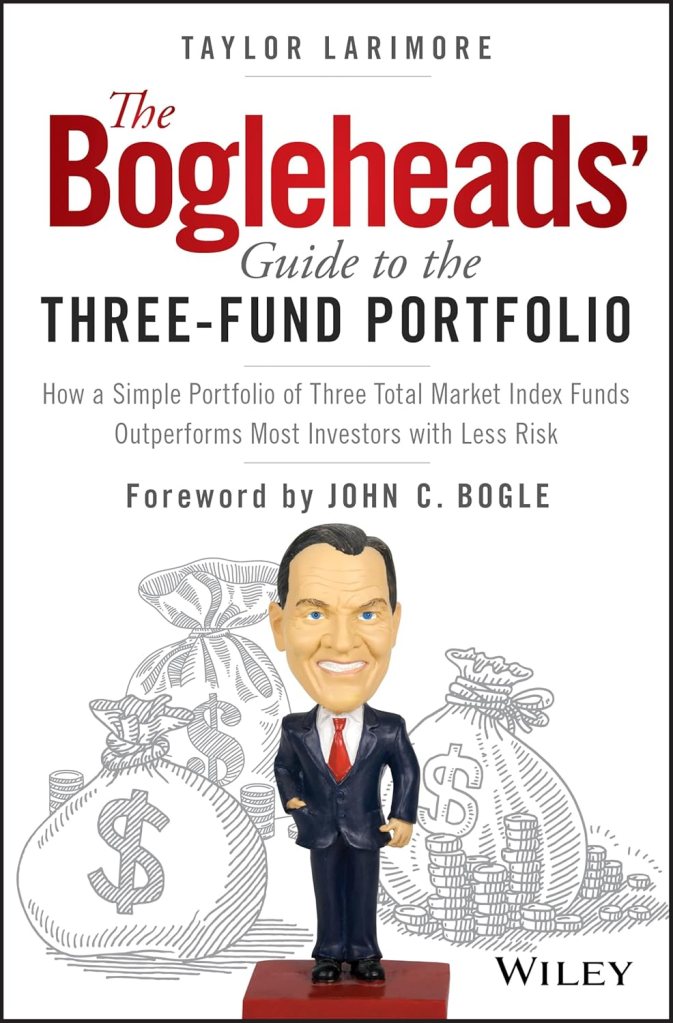
    This is exactly why The Bogleheads’ Guide to the Three-Fund Portfolio exists.

    Written by Taylor Larimore, known as the “King of the Bogleheads,” this book lays out one of the simplest and most effective investment strategies ever created. Taylor, now in his 90s, has lived and breathed this approach for decades—and his results speak for themselves.

    His core idea? You only need three low-cost index funds to build long-term wealth.


    What Is the Three-Fund Portfolio?

    The three funds represent broad exposure to the entire global market:

    1. A U.S. Total Stock Market Fund (e.g., VTI)
    2. An International Total Stock Market Fund (e.g., VXUS)
    3. A U.S. Total Bond Market Fund (e.g., BND)

    That’s it.

    These three funds collectively hold thousands of stocks and bonds, offering instant diversification without the need to pick winners or time the market. All you have to do is invest consistently, hold long-term, and stay the course.


    Why It Works: Three Big Advantages

    1. Low-Cost, High-Efficiency

    These are passive index funds with extremely low fees—unlike actively managed funds that often charge 1%–2%. Over time, this fee difference has a massive impact on your total returns.

    2. Global Diversification

    This portfolio gives you exposure to U.S. markets, international markets, and bonds—so you’re not putting all your eggs in one basket. If one market underperforms, the others can help balance it out.

    3. Simplicity = Discipline

    Because the strategy is so easy to understand, you’re far more likely to stick with it. No need to chase hot stocks or react to market noise. Just invest and move on with your life.


    Who Is This For?

    The Three-Fund Portfolio is ideal for:

    • Busy professionals who don’t have time to study the markets
    • Beginners overwhelmed by financial jargon
    • Even experienced investors who want a minimalist, high-performance strategy

    This book is a great reminder that in investing, less is often more.


    How to Allocate?

    Larimore offers general allocation guidance based on your age and risk tolerance. For example:

    • Younger investors (higher risk tolerance):
      50% U.S. Stocks + 30% International + 20% Bonds
    • Mid-career investors (balanced):
      40% U.S. Stocks + 20% International + 40% Bonds
    • Near retirement (more conservative):
      30% U.S. Stocks + 10% International + 60% Bonds

    There’s no perfect ratio, but these serve as thoughtful starting points.


    Final Thoughts: The Smartest Portfolio Helps You Sleep at Night

    The Bogleheads’ Guide to the Three-Fund Portfolio isn’t about flashy trends or getting rich overnight. It’s about building wealth safely, steadily, and with peace of mind.

    If you’re tired of noise, hype, and over-complication in the investing world, this book may be your roadmap to financial clarity.

    By making investing simple, you make your life freer.


    Ready to Simplify Your Investing?

    If this summary resonated with you and you’re ready to take control of your financial future, I highly recommend reading the full book.

    🎯 The Bogleheads’ Guide to the Three-Fund Portfolio dives deeper into the strategy, mindset, and practical steps you can take—whether you’re just getting started or looking to refine your existing plan.

    👉 Grab your copy here on Amazon:
    Get the Book on Amazon

    (This is an affiliate link, which means I may earn a small commission at no extra cost to you. It helps support this blog and keeps content like this coming—thank you!)

    Invest smart. Live free.
    You deserve a strategy that works for you—not against you.

  • If you’ve ever thought:
    “Should I learn technical analysis? Fundamental analysis? Study valuation models, earnings reports, or geopolitical trends…?”
    Then this timeless book might be exactly what you need — A Random Walk Down Wall Street by Burton G. Malkiel.

    First published in 1973, this classic remains one of the most influential investing books of all time. Why? Because it boldly and clearly presents one powerful idea:

    “Even a monkey throwing darts at stock listings can outperform professional fund managers.”


    1. Investing Isn’t About Being Smart — It’s About Being Disciplined

    Malkiel advocates for the Efficient Market Hypothesis (EMH), which suggests that all publicly available information is already reflected in stock prices. That means trying to “beat the market” through timing or stock picking is, for most people, a losing game.

    Throughout the book, Malkiel debunks many Wall Street myths:

    • Technical analysis is little more than financial astrology
    • Fundamental analysis rarely leads to consistent outperformance
    • Most actively managed mutual funds underperform index funds over time

    2. Do You Really Need to Be a Stock Market Expert?

    Surprisingly, no.

    This book shows you that you don’t need a PhD or a Bloomberg terminal to succeed. You just need a few simple principles and the discipline to stick with them:

    1. Buy and hold
      Don’t jump in and out of the market. Stay invested for the long term.
    2. Diversify
      Don’t put all your money in one stock or sector. Use index funds or ETFs to spread risk.
    3. Minimize costs
      High fees and commissions eat into your long-term returns.
    4. Invest regularly
      Use dollar-cost averaging — invest a fixed amount consistently, regardless of market highs or lows.

    3. Modern Portfolio Theory & Asset Allocation

    The book also explains Modern Portfolio Theory — the idea that combining different types of assets (stocks, bonds, real estate, etc.) can lower overall risk while maintaining good returns.

    For example:

    • Younger investors can afford to take more risk (higher stock allocation)
    • Near-retirees should focus more on stability (more bonds, fewer stocks)

    Malkiel encourages building a balanced, diversified portfolio that matches your goals, risk tolerance, and stage of life.


    4. Final Thoughts: The Simpler the Strategy, the Better the Results

    This book doesn’t promise get-rich-quick tips. Instead, it teaches you how to build wealth slowly but surely through rational, long-term investing.

    It’s a refreshing reminder that you don’t need luck or genius — just patience and a sound plan.

    “Time in the market beats timing the market.”


    Who Should Read This Book?

    • Anyone feeling overwhelmed by complicated investing advice
    • Beginners who want a smart, low-risk way to start investing
    • Investors tired of chasing trends and looking for a sustainable strategy

    One Last Question

    After reading this summary — or the book itself — how has your view of investing changed?
    Have you ever fallen for a market myth, or have you found a simple investing approach that works for you?

    Feel free to leave a comment below — I’d love to hear your thoughts!


    If you enjoyed this article, please consider sharing it with your friends or subscribing to my blog. I’ll be posting more book reviews and practical investing tips very soon!

    Grab your own copy of A Random Walk Down Wall Street and start your journey toward smarter investing today.

    👉 Buy it now on Amazon

    (As an Amazon Associate, I earn from qualifying purchases — at no extra cost to you. Thanks for supporting the blog!)